
When the image starts to pulse
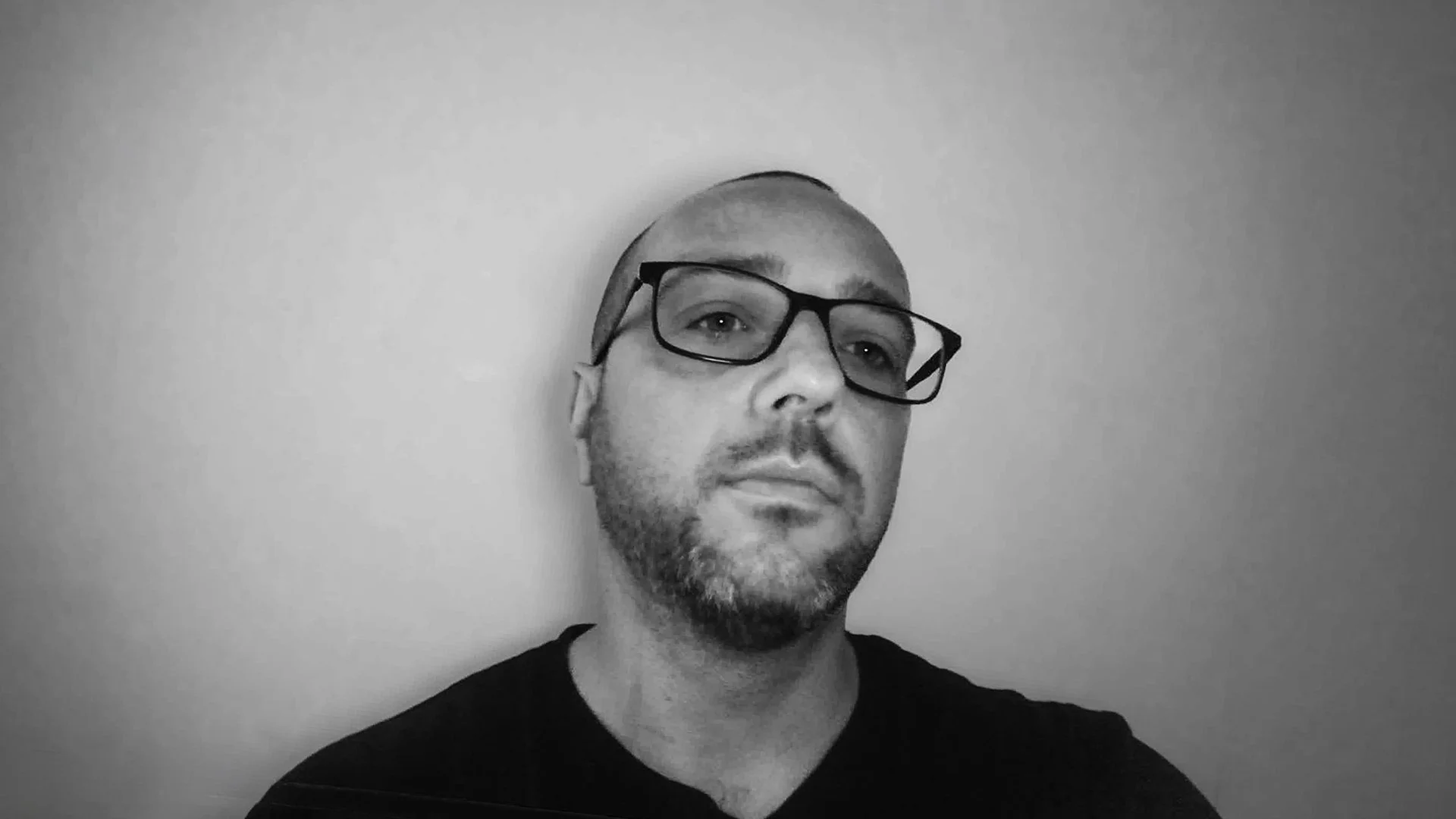
The underground has always loved that moment when the machine feels a bit too alive. In today’s electronic noise, few visual artists catch that tension as sharply as Italian digital painter Mattia Travaglini. He doesn’t just “do cover art” – he builds biomechanical mazes where maths, glitch and dark ambient moods collide, like images ripped from a modular synth in mid‑meltdown. A long‑time fan of Roel Funcken, Travaglini often cites those glitchy soundscapes as a direct influence on his 3D surrealist worlds. His latest work shapes the visual universe of Kine 3, the new album by the Dutch IDM shapeshifter on EC Underground. The music is famously unstable in the best way – glitch fragments, broken rhythm grids, elastic modular pulses. Paired with Travaglini’s imagery, Kine 3 becomes a multi‑sensory headspace for listeners who are proudly “too much” and happily all over the place.
Your digital paintings move from organic, almost biological textures to cold, mathematical fractals. For Roel Funcken’s Kine 3, how did you turn his glitchy, volatile IDM into a single image? Do you see your artwork as a calm companion to his modular pulses, or more like a chaotic parasite feeding on the noise?
Absolutely, his music was a huge inspiration for my designs. I’d actually say both: the noise and the modular pulses. The complex architecture of his sound is what really inspired me and pushed the visual direction.
You pull from a lot of different worlds – extreme metal, long industrial sessions, strict geometry. With your brain spread across so many scenes, how do you handle that inner friction? Does your style come from some hidden harmony, or is it more like letting your different obsessions fight it out on a digital canvas?
Definitely my obsessions… Sometimes it’s melodies that inspire me, sometimes it’s complex sequences of rhythms and beats, but in the end the crucial part is always inspiration – a vision. It’s like a fusion of my feelings with the music, and that’s where the style comes from.
You work deep in the world of advanced 3D and algorithmic art – JWildfire, Mandelbulb3D, Voronoi structures, complex maths, plus all the Blender work that turns those formulas into organic, living geometry. Many artists shy away from that territory because it can feel a bit cold or “too mathematical.” What do you think it is in your personality – maybe the more unconventional side of you – that lets you look at algorithms and equations and see dark, emotional imagery instead of just numbers on a screen?
Good question… I think the real key has nothing to do with maths. Whether it’s digital drawing, Blender patches or fractal stuff, what matters is putting your soul, your obsessions, your passion, your life into the work. The tools themselves don’t matter. Even if someone says the designs are “wrong” or too much of a punch in the face – chromatically or spatially – if you’re honest with yourself, then they’re right.
Your worlds feel far from everyday life – all biomech, glitch and sci‑fi fever dream. When you create, do you feel like you’re escaping reality, or getting closer to how strange it already feels inside your own head?
I do try to escape real life – the boring job routine that tries to kill me every day, the society, the so‑called “real” world. When I create, I’m moving away from that and into something that feels much closer to who I really am. That’s just me.
Your work often ends up in very limited, collectible releases. In a digital era where most artwork is just a tiny thumbnail on a streaming app, what part of you still insists it has to exist as a physical object – a vinyl sleeve, a big print on someone’s wall, something you can actually hold and stare at for too long?
As an artist, and just as a human being, I always love to actually touch the final product. In this digital era, that’s a privilege and a rare opportunity. We are still humans – we love to hold the things we create in our hands. Kine 3 and other releases over the years have made that possible in the middle of an ocean of “JPEG art” and purely digital releases, so thank you so much for that.