
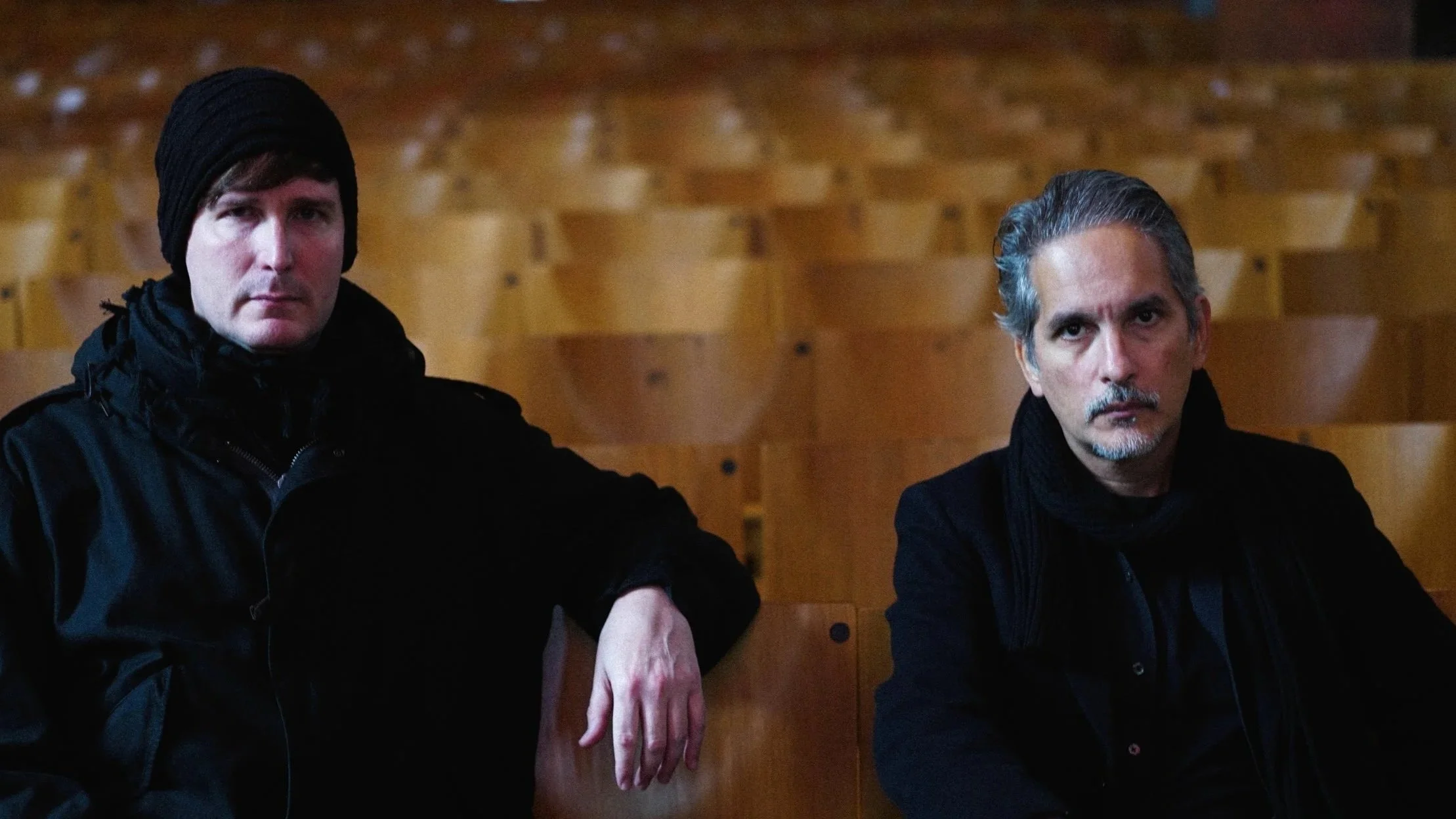
I recently caught up with Abul Mogard and Rafael Anton Irisarri to talk about Where Light Pauses in the Silence of the Sun, their new collaborative album built from recordings made during a three-day residency at Morphine Raum in Berlin. Recorded live to multitrack before being taken apart and reshaped in studios in Rome and New York, what began as a series of improvised performances gradually became something else entirely. We talked about the room as an uncredited collaborator, the discipline of letting a mistake stand rather than fixing it, and the strange process of returning to something you can barely remember and finding a record within it.
The residency at Morphine Raum removed the usual separation between performers and audience. Did being that close in the room change how you listened to each other while playing?
AM: I'd say it changes the way we play more than the way we listen. Performing in front of an audience always brings a certain excitement and, for me, a bit of anxiety too, especially before the concert begins. It's the interaction between the audience, the room, the sound system and the acoustics that shapes the performance and, in turn, the way Rafael and I respond to each other.
RAI: Yeah, exactly. What he said about the room shaping everything. That's the thing. When you're that close to the audience, you feel their attention differently. It's physical. There's no stage barrier, so the space between us becomes part of the sound. You're more aware of how the sound is hitting them, how they're receiving it. And with Abul, we don't really need to look at each other anymore to know where we're going. That proximity just intensifies it. The audience becomes another instrument in the room, you know? Their presence, their breathing, their attention. It all feeds back into how we listen to each other and what we do next. It's less about thinking and more about feeling the room as a whole organism.
You were recording each night directly to multitrack while improvising and responding to each other in real time. In retrospect, what aspects of the project could only have emerged through performance rather than planning?
AM: The interaction between us. We only plan the general shape of a performance, then follow the sounds as they develop. Often neither of us knows where they'll lead.
RAI: That's it, yeah. The thing about recording live into multitrack is you can't go back and fix it. You're committing in real time. That forces decisions you'd never make in a studio where you have unlimited takes. Every night the room was different. The acoustics, the energy, how the audience was sitting. All of that changed what we did. And with Abul responding to what I'm doing and me responding to him, there's this constant negotiation happening that you can't rehearse. The best moments came from little, happy accidents, from someone taking a risk and the other person following into it without thinking. In the studio, you'd probably undo that. But on tape, live, it becomes part of the story.
Over the three Berlin residency nights, did the material evolve gradually from session to session, or did each evening take the music in a different direction?
AM: Both. Every performance changes the way we play together, and there's a certain evolution from one concert to the next. But every room and every audience also introduce something unexpected, so the music can easily take a different direction.
RAI: Yeah, you can hear what happened the night before in the recording. You know what worked and what was acceptable. But then you walk into it the next day with a different crowd and it's like starting over. The first night we were feeling it out, learning how the space responds. By the second night we had a sense of what the room could do, so we were bolder, taking more risks. The third night was different again. It's not linear. It's more like you're building a relationship with the space and the audience, and every night that relationship is new. But underneath it all, there's continuity. We're the same players. Abul's responding to me the same way. But the context keeps shifting, so even though we're doing similar things, they sound completely different.
When you left Berlin with those recordings, did you think of them as finished performances, or as raw material that would only reveal its shape later?
AM: I didn't really think about them at first. It was a beautiful but very intense experience, and I needed some distance from it. Later Rafael suggested we listen back to the recordings, and I realised there were many improvised passages that surprised me and could become something beyond the performances.
RAI: I don't even remember playing most of it, to be honest. Everything I do on stage is improvised, nothing's planned. Most of the time it feels like blacking out, like I leave my body and just try to hold on to whatever's coming through. So yeah, from the moment we started recording, I knew it was raw material. You can't capture that much improvisation and expect it to be finished. I've struggled with a lot of self-doubt over the years. In the moment, I usually assume what I'm playing is shit. But when I listen back with some distance, I'm surprised that it feels right. I said something I didn't know I needed to say. So we let the recordings sit. We both needed distance from it. Then when we came back to listen, we heard what was actually working, what the room had captured that neither of us fully realised was happening.
Once you moved into the studio process in Rome and New York, what guided your decisions about what to stretch, remove, or rebuild?
AM: The sounds themselves guided me. Sometimes a short loop keeps drawing you back, so you begin working from there. Other times a longer section already has its own character and only needs small changes. I don't really decide in advance what should stay or disappear. That usually becomes obvious after listening to it for a while.
RAI: Abul did most of the heavy lifting in the studio, to be honest. The editing, the decisions about what stays and what goes. I listened to what he was doing and I liked it. Most of his edits felt right to me. My role was more about listening to the flow of things, making sure the narrative was working – that the pacing felt right. There was some fine-tuning to do, but not much.
At what point did it start to feel like a finished album rather than documentation of a series of sessions?
AM: As soon as we started isolating sections and working on them independently. At that point it stopped feeling like a live document and started feeling like a new record.
RAI: Yeah, that's when it clicked for me too. When Abul started pulling things apart, recontextualizing them, suddenly you weren't hearing the performance anymore. You were hearing something else entirely. A new piece. Once that shift happened, once it became clear this wasn't a live recording we were just cleaning up but actually a new work, that's when it felt like an album.
During those Berlin nights, was there ever a moment where something in the room (perhaps a frequency, a mistake, a delay) made you both stop and decide to follow it rather than correct it?
AM: In those situations, it's usually a good idea to follow unexpected sounds rather than correct them. Sometimes they're much more interesting than what you intended in the first place. That's one of the things I liked most about the Morphine recordings. There were moments I couldn't explain or recreate afterwards, and I think those were often the strongest ones.
RAI: All the time, honestly. That's the whole thing about improvising: you're listening for what wants to happen, not for what you planned. A feedback, a resonance that builds unexpectedly, something either of us does that we weren't anticipating. You don't think about it in the moment; I just roll with it. If I start to question it or even correct it, it kills the vibe and the moment. The best moments came from letting go entirely and playing in the moment, feeling the room and the audience energy as well.