
9 subcultural trends you need to know before everyone else
Culture becomes easiest to recognise when it has already happened. First something strange appears at the edges, then it acquires a name, an aesthetic and a community, and eventually a history explaining what everyone apparently missed. By then, the next thing is already happening somewhere else. Weak signals are what appear before that process is complete: small changes in behaviour, technology and aesthetics that may indicate something larger is beginning to move. Some of the terms below already exist; others are working names we are giving to patterns that do not yet have an agreed vocabulary. They are not predictions. Some will disappear, others will collide or mutate. What interests us is that they are happening now.
Anti-slop
For years, technological novelty was enough. Digital was new. Online was new. Social was new. Algorithmic was new. AI was new. Each technology produced an aesthetic around its own existence. Generative AI has accelerated that cycle almost to destruction. When extraordinary images can be produced endlessly, extraordinary images become ordinary. One response is already being called anti-slop: work that foregrounds human intervention, physical materials, awkwardness, mistakes and the evidence of making. This isn't necessarily a rejection of AI. It may be a consequence of it. If perfection can be generated infinitely, imperfection starts carrying information. A bad cut, a shaky camera or a visible fingerprint can suddenly communicate something increasingly valuable: someone was here.
The Small Web
Something peculiar is also happening to the internet. Personal websites, independent pages, human-curated directories and deliberately small online spaces are returning. The website, rendered culturally invisible by social platforms, becomes interesting again precisely because nobody has decided what you should see next. Discovery becomes an action rather than something done to you. This isn't simply nostalgia for the early internet. It reflects a growing desire for digital spaces that feel owned, specific and finite rather than endlessly optimised for engagement.
Physical microculture
The same instinct is appearing offline through zines, listening groups, workshops, screenings and tiny communities organised around shared interests rather than maximum reach. For two decades, scale became the unquestioned metric of digital success. More followers, more views, more impressions, more growth. Physical microculture proposes an almost absurd reversal: forty people deliberately gathering somewhere may represent something ten million accidental impressions cannot. Smallness stops being evidence of failure. It becomes part of the value.
Living computation
While one part of culture retreats towards physicality, another is making technology considerably stranger. Artists and researchers are already working with living neurons as computational systems. Fungi, biological networks and environmental processes are entering technological practice not merely as subjects but as components. We spent decades trying to make computers behave more like living things. Living computation reverses the proposition: life itself becomes part of the machine. This points towards something beyond our familiar distinction between nature and technology. The future computer may not look more technological. It may look more alive.
Post-silicon
Living computation belongs to a potentially larger shift. Electronic culture has historically been built around electricity, silicon and software. That definition is beginning to loosen. Biological matter, neural tissue, fungi, environmental systems and unconventional materials can now become information-processing media themselves. Technology begins to escape the box we have spent the past half-century putting it in. Post-silicon is our working name for that transition. Not the disappearance of conventional computing, but the expansion of computation into materials we previously classified as nature.
Opacity
Digital culture trained us to become legible. Define yourself. Identify your genre. Optimise your metadata. Explain the image. Choose the correct category. Give the algorithm enough information to understand where you belong. Yet artists and internet cultures are increasingly producing the opposite: ambiguity, overload, contradiction and deliberate illegibility. We call this opacity. The algorithm may detect something without understanding it. And in a culture built around classification, refusing easy interpretation starts to look like a form of autonomy. Perhaps the next underground doesn't need to hide from the algorithm. It can stand directly in front of it and remain incomprehensible.
Post-content
There is a darker signal emerging alongside this. Much AI-generated media already appears to have little interest in communicating anything. Its purpose is simply to produce a response: attention, irritation, amusement, outrage, another second of viewing. Taken far enough, content becomes detached from meaning. It doesn't need to say anything because communication is no longer necessarily its function. It only needs to work. This is post-content: cultural material understood primarily as a mechanism for producing behaviour.
Post-creator
Once content becomes a system, the creator can become optional too. Production, testing, optimisation and distribution can increasingly operate as a continuous process. Thousands of variations can be generated, measured and discarded without any individual object carrying much significance. Authorship doesn't necessarily disappear. But it ceases to be structurally necessary. For the first time, producing cultural material could become easier than deciding why that material should exist.
Collapsed musical time
Music offers another clue. New microgenres increasingly treat recorded history as though it were happening simultaneously. Sounds separated by decades coexist without the old anxiety about revivalism, authenticity or belonging to the correct historical moment. This makes sense. Someone encountering music through an infinite searchable archive doesn't necessarily experience 1993 and 2026 as historical opposites. Both arrive through the same speakers, on the same screen, available at the same instant. We call this collapsed musical time: history becoming a database. The interesting consequence may not be another revival. It may be the gradual disappearance of revivalism itself. You cannot revive something that never really went away.
What happens next
Taken separately, none of these signals predicts very much. Together, however, they suggest a deeper transition. Digital technology isn't disappearing. Quite the opposite. It is becoming so pervasive that being digital is no longer culturally remarkable. The interesting question therefore moves elsewhere. What remains scarce when images, words, music and simulations become abundant? Human presence. Physical experience. Opacity. Biological life. Small communities. Things that resist frictionless reproduction. Things that cannot immediately be classified. Perhaps we are entering a post-digital culture, not because we have moved beyond technology, but because technology has become the environment itself. Weak Signals will follow these changes while they are still unstable. No predictions and no annual list of what will be cool next year. Some signals will vanish. Some will mutate. A few may eventually become so obvious that we forget there was ever a moment when they didn't have a name. That moment is the one we're interested in. The future rarely announces itself. Usually, it begins as something nobody quite knows what to call.
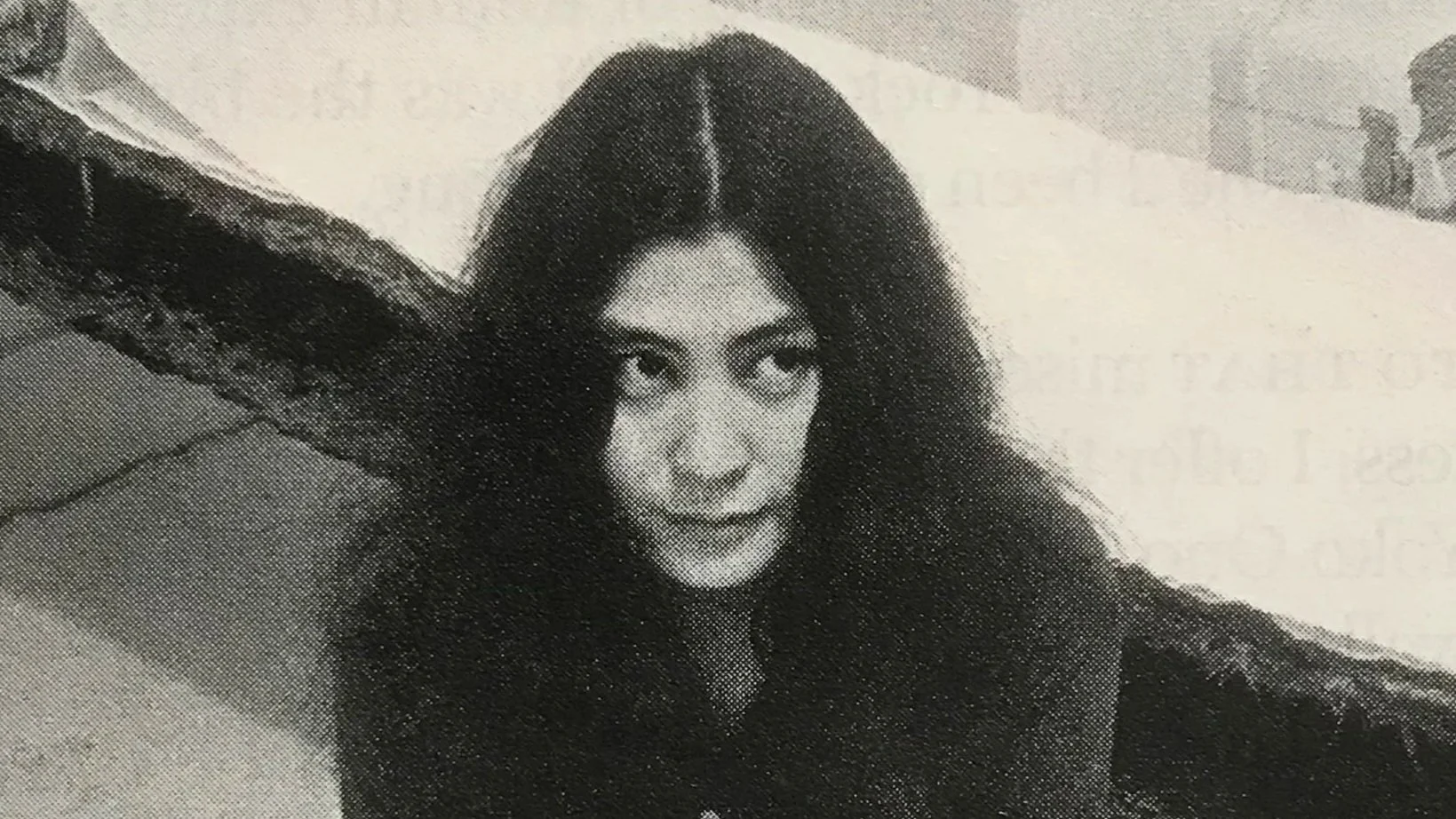
Cover photo: Yoko Ono by John Knoote
Why Yoko Ono? Because she was an extraordinary disruptor before disruption became a cliché, making work that often arrived before culture had the language to comfortably contain it.