
When artists start coding their own systems
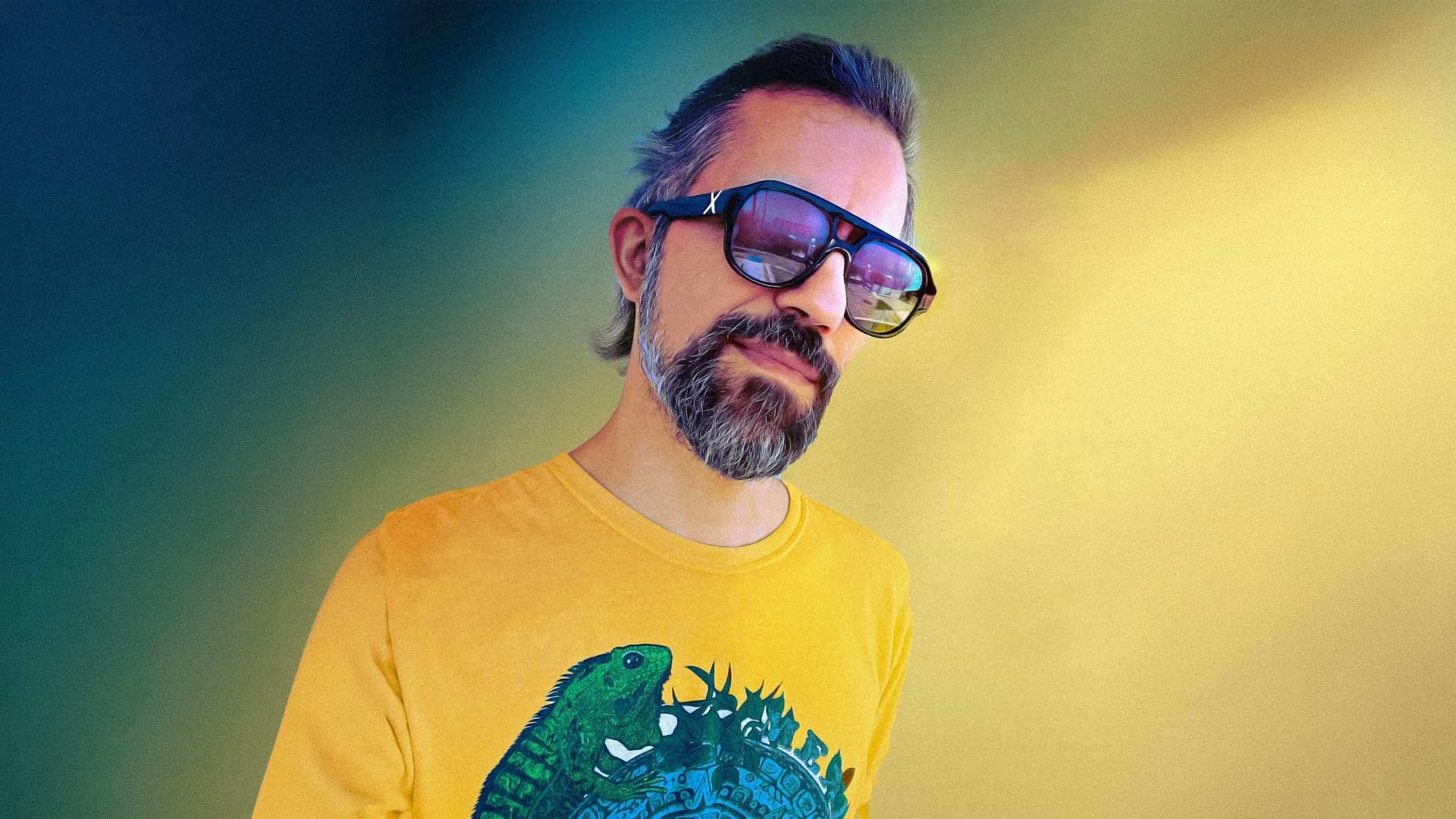
Aevin is the musical persona of Greek digital media artist Teo Tsalmpouris, whose lifelong obsession with sound has quietly shaped a body of work that blurs the lines between music, visuals, and creative technology. Growing up at the hinge point between analog and digital, Teo absorbed everything from early electronic pioneers to rave culture and IDM, carrying those influences into a distinct sonic world of nostalgic pianos, staccato rhythms, and finely detailed glitches. Alongside three albums, compilation appearances, and ongoing visual experiments, he has steadily cultivated community—first through an IDM group on Facebook and later through Nodalin, his experimental, node-based environment for real-time visuals. What follows is a conversation about crossing boundaries, building tools, and sustaining an authentic creative practice in an age of constant technological change.
Your work often sits between genres and technologies, resisting clear labels. Is that more an expression of who you are, or a deliberate push against tradition—and how does that tension shape your creative process?
Hi Flo, and thank you for the great introduction. I’ve always been fascinated by art genres, both in music and in visuals. Since my teenage years, it was kind of a nerdy challenge for me to try to put the right genre label on a song or an artist. Music genres carry the weight of their history. They come with their own feel; sometimes it’s their mood, other times it’s a particular sample or sound that differentiates one from another. However, it was often the case that an artwork couldn’t clearly be defined under a certain label. It might be a little of this and a little of that, all melted and mangled together. Such artefacts often require more of our attention. They make us lean closer to a speaker, reaching to tap replay on that one song that defies our will to continue listening to the rest of our workout playlist. The rebellion comes as a mere byproduct of what has already been there, waiting to be materialized. Authentic creative expression is an extremely conscious process, in the sense that it is driven by decisions—sculpting a sound or a visual to its own will, or allowing a happy accident to exist.
As you develop Nodalin, are there moments when the technology changes your artistic direction—and do those shifts ever make you rethink what’s possible in your work?
Although Nodalin follows a distinct design philosophy, technology has always been a driving force—perhaps even a stirring one. As an indie developer, you can set goals and features for a piece of software, but technology often dictates when the right moment is to implement them. There have been times when Nodalin wasn’t behaving the way I expected. “Just found a new bug,” I would think to myself. But at the end of the day, that erroneous behavior was sometimes creating far more visually rich results than the correct version, and so I kept it as part of the system. I would say that “happy accidents” are far more common in sound design than in software development. Unexpected sonic behavior is often embraced as uniqueness and style, while in code it is usually viewed as unstable architecture that needs to be corrected. Having said that, I’m confident that Nodalin will create a space where visual artists can express themselves and harness whatever wild pixel oddity they might discover.
If one of your visual artworks could make sound, what do you think it would ‘say’? And how might adding sound change the way you and others feel and interact with the piece?
I have actually tried that in the past with a few pieces I created in TouchDesigner. The system was able to recognize visual elements, read their color and luminance data, and convert them into sounds. In that kind of generative setup, the system itself becomes a protagonist, and the designer more of a mentor guiding it. Most of my “mute” artworks have been created while I’m listening to music, and inevitably the rhythm and vibe of what I’m hearing find their way into the visuals, often unconsciously. There have been many times when I suddenly realize that a visual I was working on fits perfectly with the music playing in the background. But just like in music composition, visual artworks are also interpretations of one’s memories and aesthetic sensibilities. Perhaps that’s why I’ve always kept both my visuals and music under the same alias.
Has breaking from norms ever made you feel creatively alone? If so, how have you turned that solitude into something that connects with others instead of pushing them away?
I wouldn’t say that I consciously rebel against rules or conventions. In fact, I often find comfort in the unconventional. Unusual sound design, reimagining workflows, or building systems that generate music—these are the things that make my mind tick. Sometimes it’s about exploring a limitation rather than breaking a rule; for example, composing music entirely on an iPad, simply to see where those constraints might lead. So the sense of isolation has never really been on the creative side. The real “distance” is usually in terms of audience size and expectations. I’m aware that the kind of music I make tends to resonate with a smaller subgroup of listeners, and that over the lifespan of a project, people’s tastes shift as technology and culture evolve around them. But that solitude has always felt more like a warm place than a lonely one. The people who do keep listening, buying, and sharing my music are incredibly meaningful to me. In a niche space, every connection feels more intentional. In that sense, isolation is not alienation—it’s simply the quiet environment where creativity tends to thrive.
In a world that loves to ‘celebrate difference’ but also sells it back to us, do you ever feel pressure to perform your uniqueness? How do you stay grounded and true to yourself amid other people’s expectations?
For an artist, the pressure often comes from within, especially when trying to fit somewhere. No matter how open or inclusive a community, a label, or an artist collective might be, there are always certain standards, aesthetics, or expectations floating in the background. Sometimes even gatekeepers. Over the years there have been moments where my own will had to be slightly tamed in pursuit of an imagined outcome. I’ve had artwork rejected for being too provocative, cover art declined because it “looked too techno,” and music described as being either too dubstep or not dubstep enough, too industrial or not industrial enough. At times, I have even abandoned tracks myself because they didn’t feel “Aevin enough.” Despite the temptation to shape things toward a wider audience, I try to stay grounded in the original motivation: creating music and visuals that feel honest to me. Something that I can return to years later and still enjoy experiencing. In recent years, building creative tools like Nodalin has also become part of that grounding process for me. Designing a system where experimentation and unexpected outcomes are encouraged reminds me of why I started making music and visuals in the first place. Artists inevitably shape the expectations of their listeners over time. But in a strange way, the most exciting audience is one that expects nothing specific. When expectations are open, the goal becomes simple: to surprise someone who is already anticipating a surprise.