
What the f*** happened in Paris?
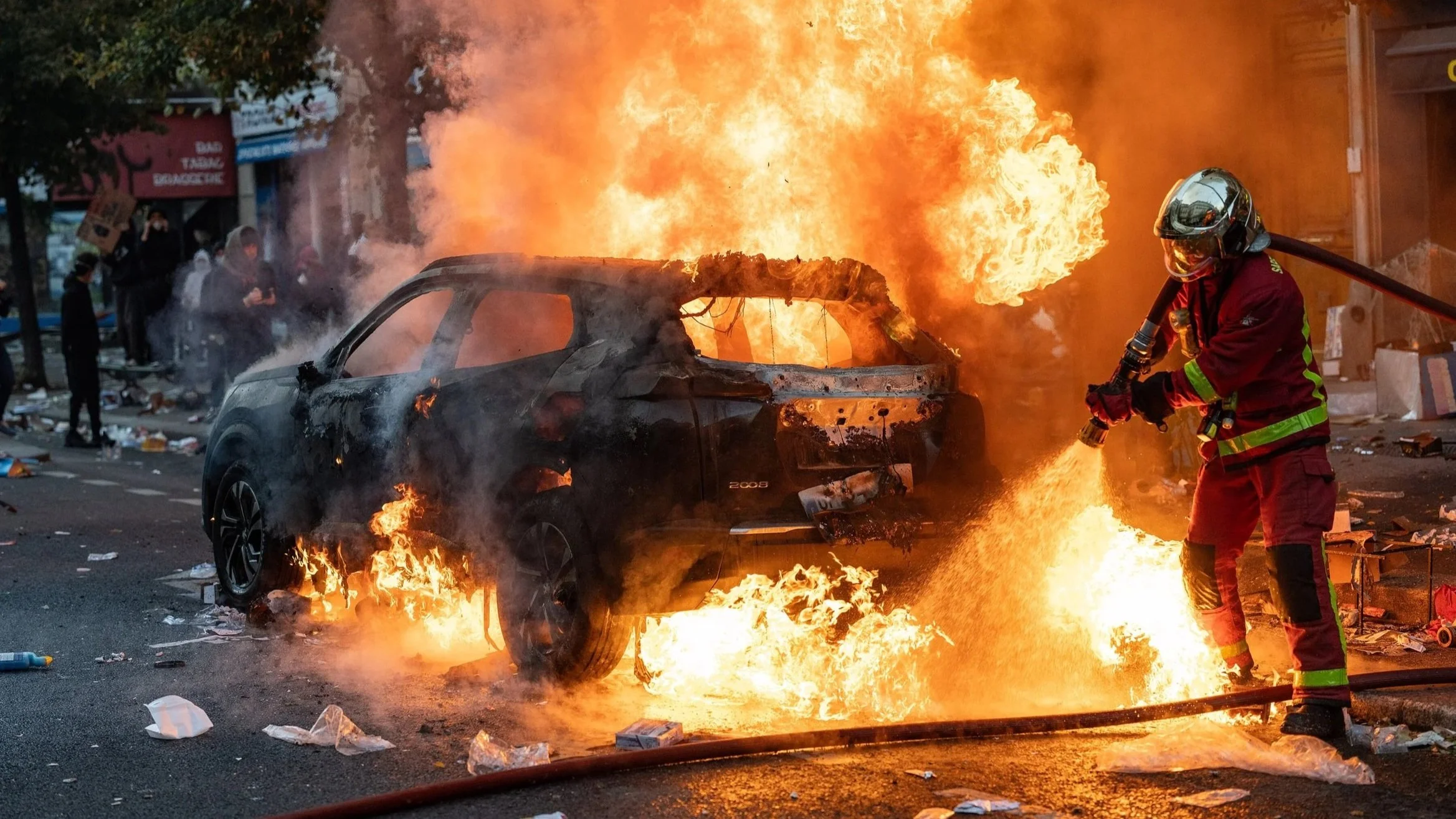
The images travelling around the world show burning cars, smashed shopfronts and a historic town hall consumed by flames. They tell us something important about what happened in France on 17 October, but almost nothing about why hundreds of thousands of people were demonstrating in the first place. According to Le Monde's reporting, approximately 550,000 people joined protests that Saturday, while organisers estimated 800,000. Most participated peacefully. Others attacked police, destroyed property or looted businesses in Paris, Lyon, Marseille and elsewhere. In Limoges, the historic town hall was devastated by fire. More than 2,400 arrests were reported during the subsequent unrest, according to Associated Press. The violence was serious, but its perpetrators must be distinguished from the much larger movement whose grievances brought people into the streets. That distinction matters because the pictures have already become political weapons. France is approaching a presidential election, its government is struggling to command parliamentary support, and competing political forces are trying to define what the unrest means. But the movement did not begin with burning buildings, immigration or an organised attempt to overthrow the government. It began with teenagers asking why their schools could no longer provide what they needed.
In September, pupils at a secondary school in Créteil, a suburb of Paris, began protesting against shortages of teachers and inadequate resources. Their complaints spread rapidly through social media and across hundreds of French schools. Classrooms were overcrowded, absent teachers went unreplaced, timetables were exhausting and buildings were deteriorating. France's university admissions platform, Parcoursup, had also become a source of anxiety for students uncertain about their future. These were not simply perceptions. According to an investigation published by Le Monde, more than 70% of classes in public general and technical high schools contained over 30 students. Public secondary education employed fewer teachers than in 2008 despite accommodating approximately 250,000 additional pupils. Young people from poorer suburbs have been particularly exposed to shortages and educational inequality. By early October, hundreds of schools had experienced disruption. Parents, teachers and trade unions joined demonstrations. Education minister Édouard Geffray subsequently promised 3,000 substitute teachers, although further reporting raised questions about whether the measure could resolve the underlying shortages. Meanwhile, rising fuel prices, living costs and deteriorating public services drew wider sections of society into the movement, including supporters of the Yellow Vests, whose demonstrations first emerged in 2018. What began as a dispute over classrooms had become an argument about the responsibilities of the state and the future being offered to an entire generation.
To understand the government's predicament, it helps to understand Emmanuel Macron's political history. Elected in 2017 and re-elected in 2022, Macron promised to move beyond France's traditional division between left and right. His presidency combined economic liberalisation and pro-European policies with a willingness to pursue controversial reforms despite substantial public opposition. His 2023 pension reform, initially raising the retirement age from 62 to 64, became a major confrontation with trade unions and demonstrators. In 2024, Macron called an unexpected parliamentary election after the far right's success in European elections. The result left the National Assembly without an overall majority: a left-wing alliance held the largest bloc, Macron's centrists were weakened and the far-right National Rally gained significant representation. Successive governments struggled to survive. Prime minister Sébastien Lecornu now faces the consequences of that fragmentation alongside severe budgetary constraints. France's substantial public debt limits the government's ability to respond through additional spending. Lecornu has promised dialogue while defending police operations. Macron has condemned the riots and demanded stronger security measures. Yet the government's handling of the protests has generated its own controversy. Thousands of teenagers were detained during the earlier student movement, while allegations of excessive police force have prompted investigations. Some young protesters have suffered devastating injuries. Police officers have also faced attacks. As Associated Press documented, France is confronting questions about both violent disorder and the methods used to suppress it. Neither violence against officers nor alleged abuses by officers can be excused by the political position of those involved.
France's opposition is divided over how to respond. Jean-Luc Mélenchon, leader of the radical-left La France Insoumise, has championed the student movement and accused the government of escalating tensions through repression. He has also publicly rejected looting and destruction, as Le Monde reported during the 17 October demonstrations. Trade unions, including the CGT, are demanding practical responses to economic grievances and guarantees for the right to demonstrate. Socialists, Greens and other left-wing groups share concerns about public services but disagree over political strategy. Meanwhile, investigators must establish responsibility for the destruction. Authorities have identified masked militant groups and opportunistic criminals among those involved, but the precise affiliations and motives of individual perpetrators cannot be assumed. The mayor of Limoges has accused the ultra-left of organising the attack on his city's town hall, although the investigation remains ongoing. The images of violence have obscured another important development: young people who had little previous involvement in politics have organised collectively and challenged government decisions. France has a long tradition of protest, from the student and workers' mobilisation of May 1968 to the Yellow Vests. The present movement belongs to that history, although its immediate demands concern the quality of everyday life rather than a single sweeping revolutionary programme.
The far right is another central actor in this crisis. Marine Le Pen and National Rally president Jordan Bardella have presented the unrest as evidence that Macron's government has lost control of public order. As Le Monde reported, both have linked the destruction to the radical left, seeking to distinguish what they regard as legitimate social grievances from those they accuse of encouraging disorder. National Rally's programme goes considerably further than policing. Its published political proposals include stricter immigration controls, restrictions on access to certain social benefits and a policy of "national preference", giving French citizens priority in important areas of public provision. Supporters describe these proposals as protecting national sovereignty and citizens' interests; critics argue they threaten equal treatment and fundamental rights. It is important to establish what has not happened: the far right has not taken power in France, and immigration was not the cause of the student protests. Nevertheless, US president Donald Trump has attributed the riots to migrants and Muslims without supporting evidence, a claim challenged by Macron and examined by Associated Press. Such misinformation redirects attention from the conditions that prompted the demonstrations towards the identities of people being blamed. Macron is due to leave office in 2027, with a presidential election scheduled for April and May. Further demonstrations are planned for 24 October, and unions have called another mobilisation for 5 November, according to AFP's latest reporting. The young people who began protesting about missing teachers now face a national debate in which their original demands compete for attention with burned buildings, police deployments, presidential ambitions and arguments over who belongs in France.