
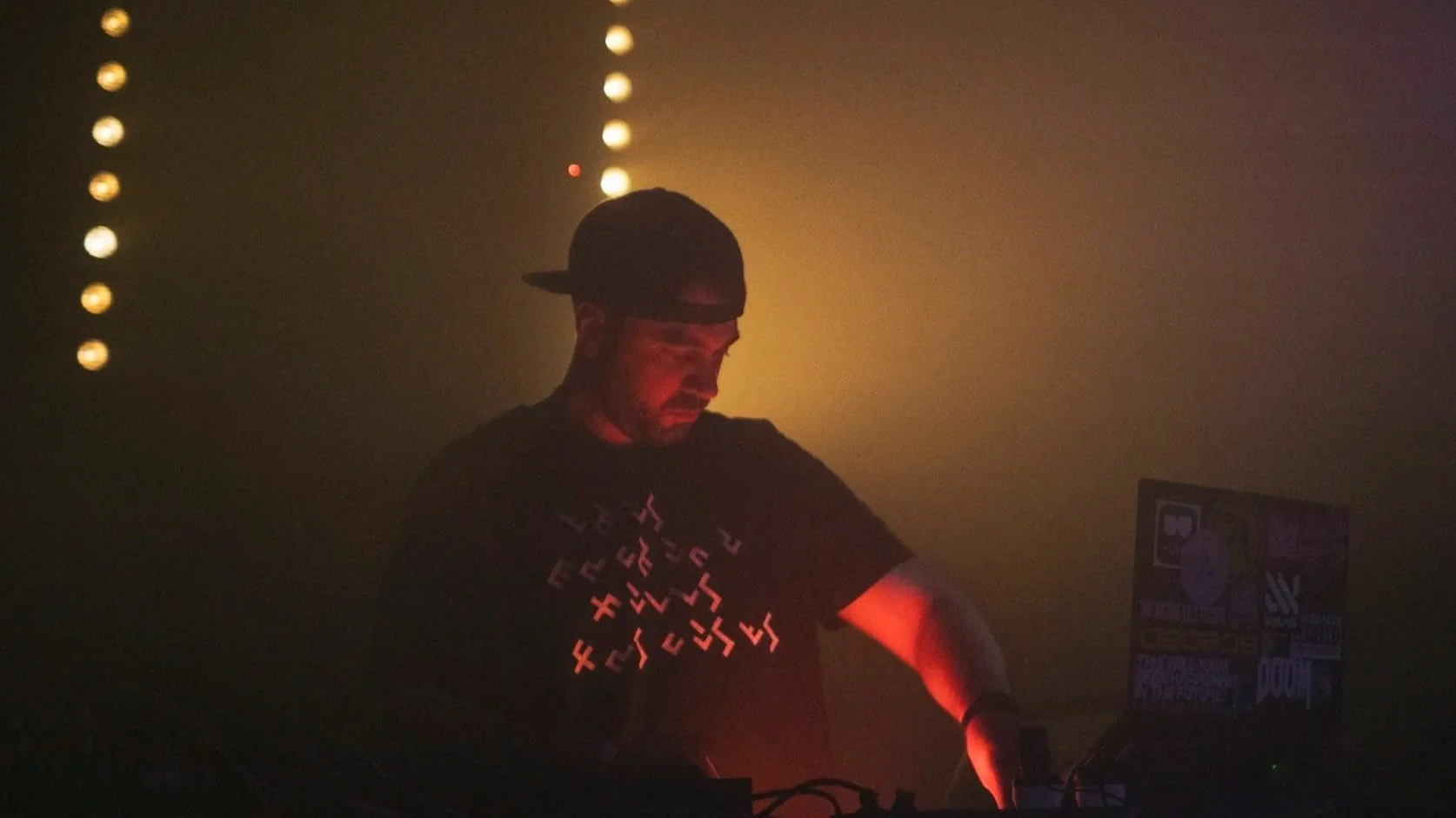
You often talk about sound like architecture, almost like you’re building impossible structures. Where do you think that impulse comes from in your personality – were you always the type to over‑engineer things in your head?
I think I’ve always formed strong, almost obsessive attachments to places and the memories connected to them. Whatever we do in a place leaves a mark of our passage, wherever it is. Even now, I can become emotional when I return to places where I spent a lot of time: an old apartment, a school, a friend’s house. It probably started when I was eight and my parents moved from the center of Padua to the outskirts of the city. Losing the place I called home felt like a betrayal. It was as if all the good memories I had made there had disappeared, and moving elsewhere meant I could no longer continue living in the space where I had essentially grown up. Maybe that’s why I always found it difficult to leave familiar environments and take on new ventures — a fear I eventually overcame, even though my attachment to places never really went away.
Music had, and still has, much the same effect on me. In that first home, my father played music constantly: everything from Black Sabbath and Pink Floyd to Enya, Enigma, Deep Purple, Jean-Michel Jarre, Yanni, Tangerine Dream, and obscure New Age compilations he had somehow managed to find. It created a magical atmosphere that became inseparable from the environment itself. Even now, hearing those songs instantly takes me back there. I think that was the first connection I made between buildings, environments, and music. The fact that sound behaved like imagery only deepened that connection. I started “over-engineering” music very early, associating images with sounds almost involuntarily. I remember a teacher at nursery saying “uno alla volta” — “one at a time,” while keeping us in line for the canteen. The phrase would trigger a vivid image of strawberry ice cream with a cherry on top, simply because of the way those words sounded to me: soft and sweet.
That episode was what first made me wonder whether I might have some form of synaesthesia — although it’s really just my own way of describing what happens in my head, rather than anything clinical. Combined with my attachment to buildings and spaces, it helped shape the workflow I still use today: constructing music as if it were an actual building, where every element contributes to the whole, just as each brick contributes to a structure. As I grew older, my interest in design and architecture developed alongside my growing musical vocabulary. The more unusual ideas architects tried to express through buildings began to influence the way I approached tracks. I started thinking in terms of load, weight, and support, rather than only melody and rhythm: which sound needs to carry the structure, which one is decorative, and where space is needed so everything else doesn’t collapse in on itself.
Remove one sound, and the whole thing can suddenly feel wrong — as if you had taken away a foundation or a window. The music technology course I later attended helped me turn this into a working method rather than relying on intuition alone. I’m sure a real architect would laugh at how casually I use these terms, but that’s probably the clearest answer: yes, I’ve always over-engineered things in my head. I just didn’t have a name for it until much later. This version is still substantial, but it reads as one continuous story and removes some repetition. For a shorter magazine interview, I would cut the list of artists your father played and shorten the nursery example, but I would not remove the moving-house story or the final architectural explanation. Those are the emotional and conceptual anchors.
Your music can flip from rave chaos to extreme detail and control. In your everyday life, where do you feel this same tension between total precision and total mess the most?
I’d say my flat. I’m a creature of habit, but my home is in a constant state of chaos. I’ve always been a bit lazy when it comes to that side of things. The chair — or the bed — has traditionally doubled as a second wardrobe. It’s something I’m actively trying to improve as I get older, even if I don’t particularly enjoy it. Putting things away always feels like time I could be spending on something more creative. It’s funny, because the same tension used to appear almost identically in my music. As a teenager, the ideas were often genuinely good: I could hear something interesting in my head, but the execution was a mess. Tracks were unfinished, poorly mixed, and structurally all over the place. Good ideas, poor follow-through — basically the audio version of my bedroom at the time.
I think becoming more responsible in everyday life and becoming more disciplined with music happened in parallel, almost without me planning it. I learned to sit with a track and finish it properly: mix it, arrange it with intent, and not simply chase the next idea. At the same time, I started applying that patience to things like tidying up and staying on top of admin, even when every instinct tells me I’d rather be doing something else. So the mess is still there — in my flat, and probably in my head too. But I’ve become much better at knowing when to let things stay chaotic and when to sit down and sort them out. Chaos and control were never really opposites for me; control just took a lot longer to learn.
Moving from Padova to London to study Music Technology feels like a big personality leap. What part of your character made you say “OK, I’m going to uproot everything for this,” and how did that move change the way you see yourself?
Somehow, I always felt a connection to London. I remember being thrilled by The Great Mouse Detective as a child — it was my first encounter with the city. As I grew up, I realised that much of the music I was obsessed with came from the UK. It started with WipEout 2097 and its fantastic soundtrack, featuring artists like Underworld, The Chemical Brothers, The Prodigy, The Future Sound of London, Photek, and Cold Storage. That was my first real glimpse of the world I wanted to be part of. In the early 2000s, I began following the new breakbeat scene closely, especially artists like Plump DJs and the releases on Finger Lickin’ Records.
I saw London as the place for me, but I never quite had the courage to move there. Then, around ten years ago, the push finally came: my then-girlfriend, now wife, moved to Warwick for her PhD. At the same time, I wasn’t satisfied with my working life in Padova, so I finally started considering the leap seriously. I had also become increasingly interested in mixing and mastering, working online with a close friend who introduced me to that world. I began looking for a proper course, and that’s how the whole new adventure started.
Looking back, I think it took a mixture of romantic stubbornness — chasing something I had wanted since childhood — and being just fed up enough to finally act. The move changed me from someone who constantly talked himself out of big decisions into someone much more comfortable taking the leap and figuring things out afterwards. Moving to a country where I didn’t speak the language fluently, and building an entirely new circle of friends and contacts, would have seemed impossible to the version of me who had spent years admiring London from a distance.
You work under several aliases (DJ Cheeky Gory, Raving Kid, SLOW_BRO) plus your own name. If each of these was a different side of your personality at a party, what would they each be doing in the room?
Marco Simioni would probably be the most responsible of my musical personalities. He’d be chatting with people and trying to make new friends, although he might come across as slightly strange or shy depending on the moment. Or he’d be standing in a corner, quietly observing everyone else and already figuring out how to get home and start making music. DJ Cheeky Gory would be dancing his arse off to the hardest tracks until sunrise. He’s my techno side, and he might get a little harsh or stir things up on the dance floor when the energy is right. Nothing below 145 BPM for him. I’ve only released one remix under this alias so far, but more tracks are on the way.
Raving Kid would be easygoing, dancing to old rave classics and getting emotional over 808 State, A Guy Called Gerald, Humanoid, Orbital, and Shades of Rhythm. He’d hug everyone and spread the love, while carrying a quiet sadness underneath: the feeling that the world he loves is gone and will never return. He lives in the past and is perfectly happy there. SLOW_BRO would be glued to the sofa all night, probably high as a kite. He’d be the person you end up talking to about spirituality, quantum physics, manifestation, and everything else, although he might struggle to finish a sentence. He was my first project, focused on vaporwave, and there may still be an unreleased album from more than ten years ago waiting somewhere in the shadows. Together, they’re less like separate characters than different rooms in the same slightly chaotic house.
Your music combines dense, “nerdy” studio detail with a deeply emotional and unhinged energy. Was there a specific moment when you realised that your obsessive, restless, slightly weird quirks were artistic strengths rather than flaws?
Aphex Twin has always been my biggest musical inspiration. His approach to music is incredibly diverse, spanning everything from ambient and harsh acid techno to furious IDM with hints of jungle, punctuated by tender melodies and atmospheric passages. That spectrum is exactly what I’ve wanted to achieve with my own music: refusing to be confined to a single genre or formula tied to one particular sound. My influences come from so many directions that forcing myself into a fixed sonic profile feels completely counterintuitive. I’ve always preferred to experiment with different sounds and discover something new with each project, rather than ironing out the quirks just to fit into one lane.
I started making music years ago purely out of passion, without worrying about external opinions. For me, making music has always been a form of meditation: a dedicated space to turn inward, confront my personal shadows, and transform darker impulses into something meaningful. I never planned projects around a specific number of tracks for an EP or album. Technically, I was quite limited back then, and the music was often unfiltered, raw emotion without much structure, but I kept most of those early drafts.
Eventually, I decided to take my artistic output more seriously and build proper, finished releases. I also made the mistake of trying to constrain my sound, aiming for something radio-friendly and club-ready for DJs. It became quite formulaic. It took years of trying to sound “proper” before I understood that my restless, over-engineered quirks were not flaws. They were the very elements giving the music its soul. Once my technical skills almost caught up with my vision, I found a process that felt completely authentic to who I was, and I’ve stuck with it ever since. Ultimately, it comes down to staying true to your vision and hoping it resonates with someone on the same wavelength. Even if it doesn’t, you’ve still spent your energy on something genuine. Everything else is just background noise.
Cover photo by Clara Wildberger