
Ashley Ray Simon and the quiet return of pagan music
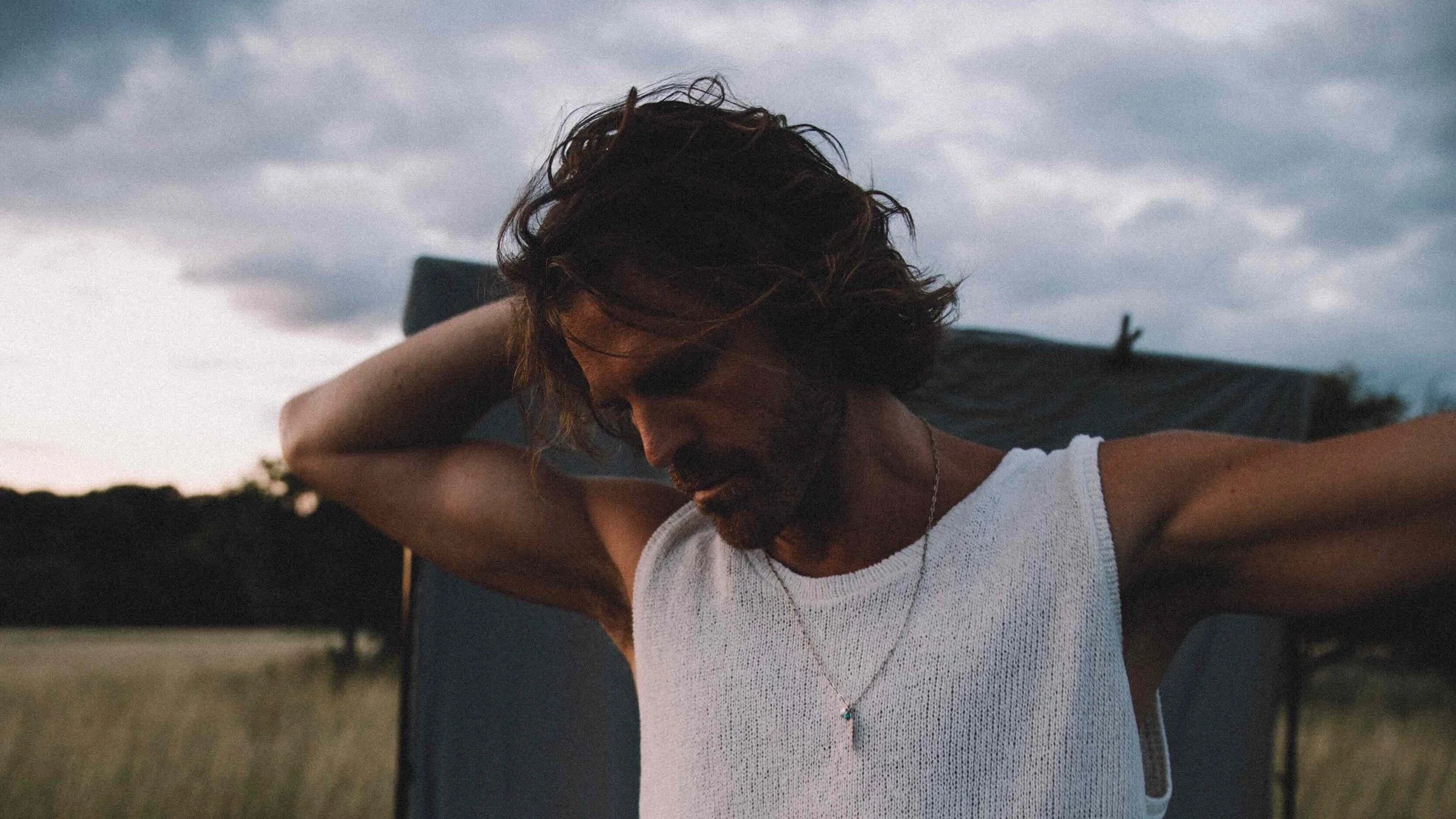
Britain’s experimental underground continues drifting toward pagan imagery. Across art-pop, experimental folk and post-indie scenes, artists are moving away from polished futurism and back toward folklore, ritual, environment and emotional ambiguity. Not necessarily in an overtly spiritual sense, but through atmosphere and instinct. After years dominated by hyper-curated online identity, therapeutic language and algorithm-friendly clarity, the mood has shifted toward music shaped by erosion, geography and human imperfection rather than branding, by uncertainty instead of certainty. Ashley Ray Simon’s Pagan Roman Daydream fits naturally into that cultural shift. Even the title feels loaded with old-world symbolism, evoking fragments of forgotten Europe rather than contemporary indie culture. Reissued ahead of a new body of work expected later this summer, the EP arrives less like a retrospective and more like the continuation of an artistic language rooted in erosion, distance and emotional impermanence. Originally released under a previous moniker before Simon adopted a new name inspired by his grandfather, a musician and instrument builder, Pagan Roman Daydream already carries the feeling of inheritance and reinvention. The project is framed around heartbreak, but not in the modern self-optimising sense where pain must immediately become recovery. Instead, the emotional tension remains unresolved, suspended in the air like incoming weather.
The setting behind the record reinforces that atmosphere almost too perfectly. Pagan Roman Daydream was recorded live in a remote Cornish studio accessible only by boat, alongside musicians connected to Nilufer Yanya and Puma Blue, with production from Moses van den Bogaerde. Cornwall continues to occupy a peculiar place within British cultural imagination, somewhere between coastline and folklore, modernity and pre-Christian memory. Simon’s music does not lean into folk revivalism directly, yet the geography surrounding the project shapes how it is perceived. Britain has long produced artists fascinated by ruins, storms, isolation and fragmented identities, particularly in periods where mainstream culture begins to feel emotionally exhausted. The recent resurgence of folk horror aesthetics, analogue textures and loosely performed music reflects a broader desire for friction and imperfection in reaction to increasingly frictionless digital life. Simon’s obsession with “feel over grid” speaks directly to that tension. His work moves away from precision without romanticising chaos, preserving the unstable pulse of live performance rather than sanding it into algorithmic smoothness. Even the move toward unquantized drum machines in his forthcoming material suggests an artist trying to humanise mechanical repetition instead of submitting entirely to it.
That same instability runs through “Hound Dog”, the EP’s lead single featuring Celtic trip-hop vocalist Clara Pople. The song explores the strange emotional territory where relationships continue existing despite already beginning to disappear. Simon describes it as the moment where everything feels heightened precisely because it cannot last, and that emotional contradiction becomes the core of the track. “Darling I’m yours / For now” captures the atmosphere perfectly: intimacy contaminated by impermanence. Importantly, the song refuses the neat emotional arcs that dominate much contemporary songwriting. Nothing resolves cleanly. Nobody becomes stronger. Nobody arrives at clarity. The emotions remain suspended between longing and withdrawal, devotion and emotional distance. That refusal to impose meaning onto heartbreak gives the record a rare sense of honesty. Contemporary culture increasingly demands explanation and self-awareness from artists, particularly online, where emotional experiences are often flattened into digestible narratives about growth or empowerment. Simon instead allows uncertainty to remain uncertain. The songs feel inhabited rather than analysed. Even moments of restraint, like “Cause I act so far above it,” suggest somebody observing their own emotional performance in real time without fully understanding it.
Living in Portugal while carrying a distinctly British coastal sensibility only deepens the atmosphere surrounding Pagan Roman Daydream. The record rarely feels urban or contemporary despite its experimental pop textures. Everything points outward toward cliffs, tides, weather systems and disappearing horizons. Even the recording process itself becomes part of the mythology: musicians travelling by boat to an isolated Cornish studio to document songs built around looseness, fragility and instinct. In another era this kind of imagery might have been dismissed as overly romantic, but it increasingly mirrors a broader exhaustion with frictionless digital culture. Younger artists appear less interested in futuristic perfection than in reclaiming texture, space and human inconsistency. Simon’s fascination with unquantized rhythm and emotional impermanence belongs to that movement without sounding self-conscious about it. Pagan Roman Daydream does not present itself as escapism or nostalgia. If anything, the record feels like somebody trying to preserve small traces of humanity while standing inside an increasingly artificial environment, holding onto instinct before everything becomes overly explained, overcorrected and emotionally optimised.