
Why I trust my flaws more than your expectations
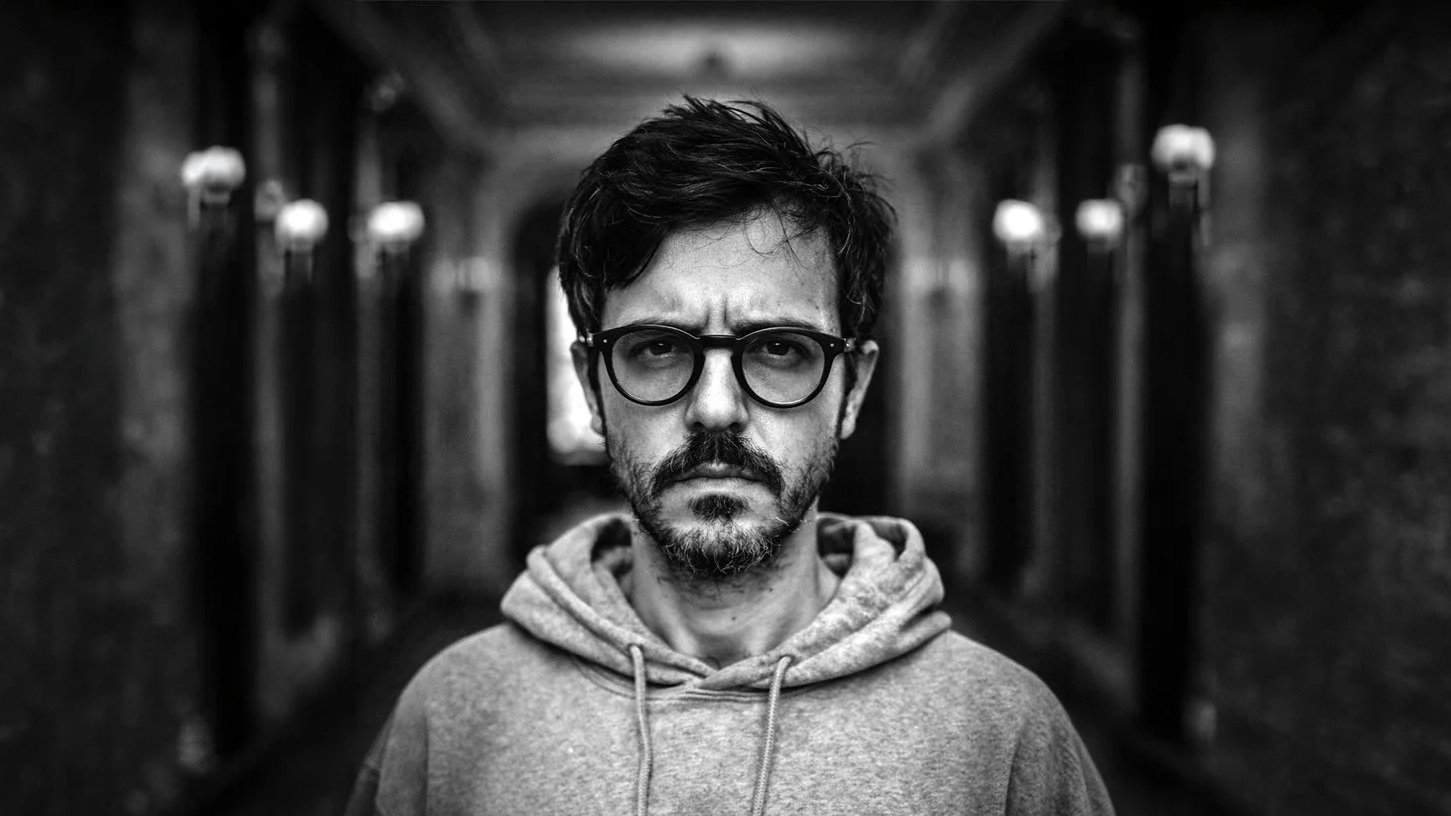
For more than two decades, Wahn has stood as a quietly uncompromising force in Bretagne’s electronic underground. From Rennes, he has carved out a singular path through IDM, ambient, dub, and bass music, favouring deep exploration over fleeting trends. A key presence in the Laptop Session collective, he treats electronic music not as a lifestyle accessory but as a living, breathing language—one worth defending against homogeneity and easy nostalgia. In this Q&A, we talk with Wahn about the long arc of his Drifted series, his fascination with texture and duration, and how those slow-burning explorations translate into the physical, immediate space of live performance.
In IDM, the most beautiful moments often come from a “glitch” or an error in the sequence. What is a personality trait of yours that society might label as a “flaw,” but that you experience as your most essential creative spark?
I live in a kind of nonchalance that borders on carefreeness, a radical detachment from the course of things. What’s done is done, and what hasn’t happened yet isn’t worth stressing over. It’s a state of deliberate emptiness. In social life, this letting go passes for indifference, but in the creative space, it becomes my natural filter. I feel no need to explain myself or conform. Yet this natural drift requires certain limits: I impose strict deadlines on myself, cutoff dates that act as engines capable of pulling my music out of inertia. On the production side, if a sound doesn’t move me in the moment, I don’t persist in that direction. This absence of effort allows me to preserve a space where the music simply exists, for itself, without having to apologize for being there.
Many IDM artists work in a kind of sonic solitude to build such intricate worlds. Do you feel that your uniqueness requires a certain distance from conventional social norms in order for you to stay truly authentic?
Solitude is my natural way of functioning, an imprint left by an only-childhood. It’s not a pose, but a territory of freedom where you don’t have to answer to anyone. I’m an introvert who speaks little and finds crowds a source of nervousness, a kind of background noise. I don’t try to join groups just for the sake of social convention. Paradoxically, this distance makes my chosen bonds stronger, as with the Mahorka collective, which I’m proud to be part of, as it embodies a gathering of singularities. Releasing an album like Echo Mist Light is, for me, a way to strengthen this independent structure, so that Ivo, the boss, can continue to keep this netlabel alive, far from market-driven logic. I accept current tools — Spotify, search indexing — as one pays a toll, but deep down I remain impervious to trends, faithful to my own inner geography.
In Drifted Live, you let sounds slide away from their anchors to create something physical and immersive. How does this mirror your unconventional personality? Do you feel most at home when you’re intentionally drifting from what society considers “on track”?
My approach is to let the sound live, to watch it lose its anchor points, which exactly reflects my relationship to the world. I don’t handle my emotions very well; they often overwhelm me. I’m not a studio technician, and I can’t play any musical instrument. Creating is my therapy, my only way to order the chaos. I try to evoke a state of reverie or melancholy, an ancient energy that flows through me, without my being depressive at heart. To drift is to accept that control is only a fragile backdrop. I feel closer to the truth when I let my emotions express themselves freely, in that slow zone where time seems to stretch and I have to remember to breathe.
The Drifted series is designed for live performance, where sounds can shift, evolve, and move away from their original anchor points. In a culture that pressures us to stay on track and fit into rigid categories, how has this act of “drifting”—in your music and your life—helped you find a more authentic sense of direction?
We live in a time that demands clear-cut categories, sealed boxes where algorithms try to pin us down. My work is an attempt to step off those tracks, a refusal of the imposed trajectory. The Drifted series was conceived as a process of deliberate disconnection: releasing each volume on a different label, in a different country, is like drawing lines of flight on a map, connecting points that are unaware of each other. I invite the listener to become an explorer of their own feelings again, to leave the beaten paths and experience the unknown. There is a quiet sense of reward in seeing new horizons open up for those who might never have sought them out. I myself spent a long time wandering in search of a musical identity; it is probably through drifting, by accepting to lose myself, that I finally embraced my love for ambient music. I needed those detours, those sidesteps, to at last cross the threshold and let this music come into being.
Your performance invites the audience into a space where darkness, tension, and faint light coexist. Many people fear the darker, more chaotic parts of themselves. How has embracing those tensions in your music helped you celebrate the uniquely weird aspects of your humanity?
Music is my only expansive language. Because I struggle to express my emotions, it allows me to externalise what I usually keep to myself. Despite the positive feedback I receive from artists I admire, I carry a constant sense of being an impostor, a feeling that I don’t truly belong among musicians. This is probably the legacy of an upbringing steeped in guilt. My music is the place where these tensions — the heavy weight of the bass and the fragile glimmers of the piano — coexist without cancelling each other out. By accepting this inner disorder, I am not trying to appear unique; I am simply trying to be accurate. It is in this chiaroscuro, between the weight of sound and the fragility of the note, that I find my own human coherence.