
We don’t need more mirrors, we need more doors
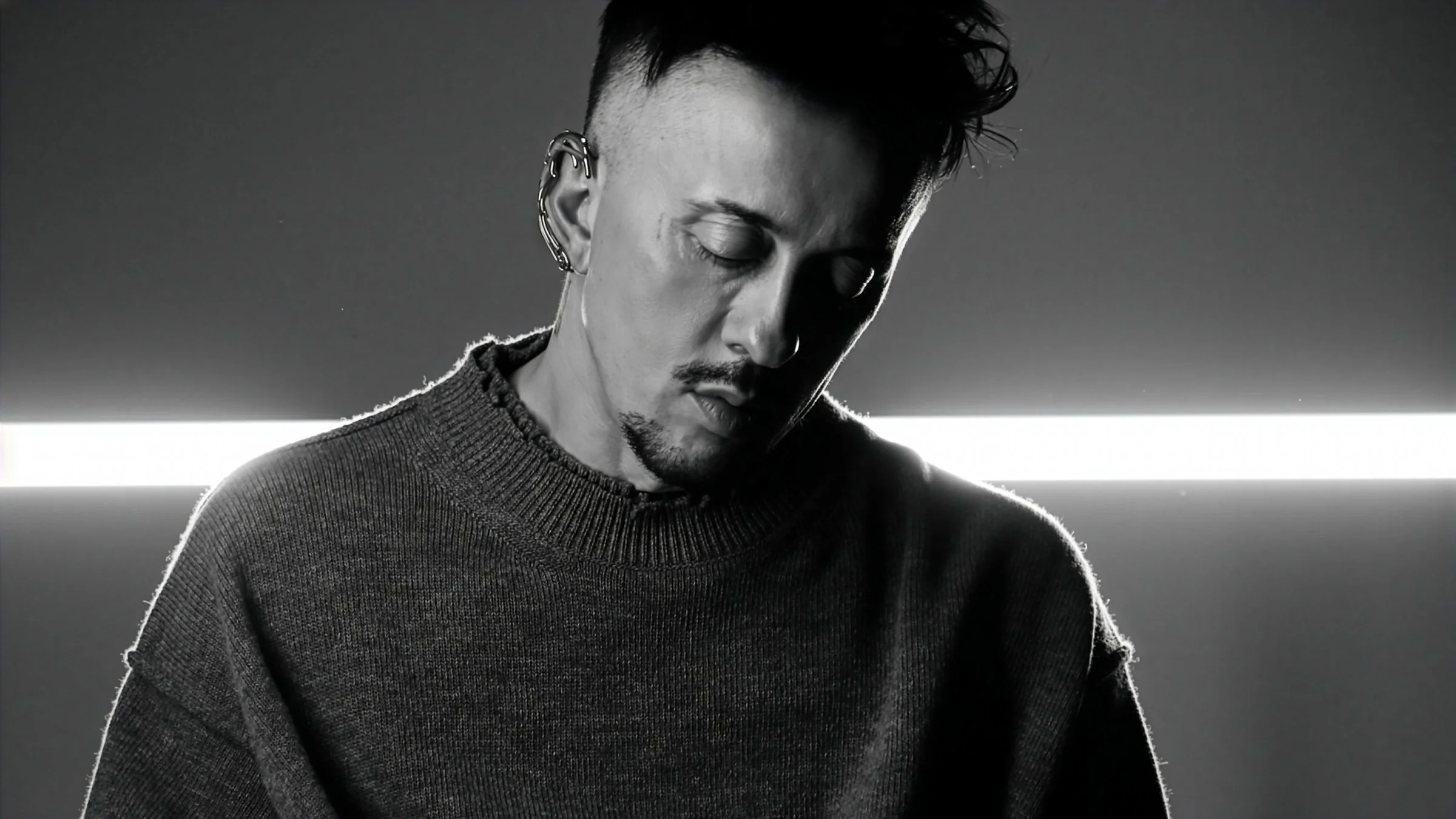
Dardust has built a reputation on navigating the space between worlds, not choosing between piano and electronics, but treating them as two sides of the same language. At a time when identity itself feels increasingly constructed and exposed, his work circles around a quieter question: what happens when we stop looking at ourselves and start moving through something else? “I think it starts from something very personal, almost instinctive. I’ve always felt uncomfortable with mirrors, not in a literal sense, but in what they represent: a closed loop, the ego reflecting itself endlessly. Doors, instead, are thresholds. They imply movement, transformation, the courage to step into something unknown.”
What begins as an internal discomfort quickly expands into something generational. “We live in a time where we are constantly pushed to look at ourselves, to define ourselves, to build an identity that is visible and validated. That’s the mirror. The door, instead, is the possibility to escape that pressure. To become something else. Or even better, to not be defined at all.” That refusal to be fixed extends into his relationship with sound. “For me, piano and electronics have never been separate worlds. They are two sides of the same language. The piano is intimate, human, imperfect. Electronics are architectural, infinite, sometimes inhuman. I’ve always been fascinated by this tension.”
Rather than choosing between traditions, he treats them as opposing forces that need to coexist. “Electronic music allows me to expand the piano, to place it in spaces that don’t physically exist. It’s a way to build new environments, new architectures of sound. It’s not exploration for the sake of novelty. It’s more about necessity, finding the right form for an emotion that the piano alone cannot fully express.” There is an awareness of lineage, but also a deliberate distance from it. “I have deep respect for Oneohtrix Point Never and Lorenzo Senni, and for composers like Claude Debussy and Brian Eno. But I try not to listen too much when I’m creating. I want to carve out a kind of void, a space free from references, so that what emerges feels personal and unfiltered.”
That idea of space becomes literal in the way he imagines the listener. “For me, inspiration often comes from spaces, physical, emotional, architectural. I like to listen to places before I write: cities, landscapes, empty rooms. Those environments shape the music.” The audience, then, is not something to satisfy, but something to host. “I don’t consciously think about the listener in terms of expectations. If I start composing to meet expectations, I lose honesty. I imagine them entering the sonic space I’ve built. The music becomes a place rather than a message, maybe even a shelter from the relentless noise of everyday life.”
It is perhaps inevitable that this thinking would shift when confronted with a context where the idea of limitation itself is redefined. Reflecting on his involvement in the Milan Cortina 2026 Paralympic Games, he frames it not as inspiration, but as correction. “That experience made me realise that what we call limits are often just a mismatch between the body and the environment. I felt a very strong sense of human presence, of resilience, but also of transformation. The idea that a limit can become a new form of movement, a new architecture of balance.” Which brings us back to a line that reads less like a conclusion and more like a quiet manifesto: “we don’t need more mirrors. We need more doors.”